A distributor walks into a retailer to sell beer.
The retailer carries one brand from a portfolio of six. But the distributor knows the retailer's crowd would love a second brand they don't carry yet. The pitch works. The retailer says yes.
Now the distributor needs a poster. Today, before the retailer changes its mind.
If that distributor has to email someone, wait for a response, and hope the file arrives before the moment passes, the sale gets harder. If they can log into a portal, find the right brand's current poster, download it, and send it straight to a printer, the sale is already closing.
This is the exact scenario a multi-brand beverage conglomerate we work with deals with every day. A dozen brewery brands under one parent company, sold through hundreds of independent distributors across the country, each one needing instant access to exactly the right brand assets at exactly the right moment.
I've talked to a lot of multi-brand companies this year. Beverage portfolios, architecture firms with multiple studio brands, agencies managing several client identities under one roof. The pattern is the same everywhere: multi-brand distribution isn't a bigger version of single-brand distribution. It's a different problem entirely.
The Problem With Treating Multi‑Brand Like One Big Brand
Most DAM systems handle multiple brands by adding permissions on top of one shared library. Everything lives in the same pool of assets, and access gets controlled with folders and user roles layered on afterward.
That works until it doesn't.
Here's where it breaks down:
- A distributor selling three of your six brands sees folders, tags, and search results cluttered with brands they don't carry. They waste time filtering out noise to find what's actually relevant to them.
- Brand teams lose confidence that their assets stay contained to their own audience. Nobody wants Brand A's unreleased campaign visible to someone who only has access to Brand B.
- Every new brand added to the portfolio means more permission rules to maintain, not a cleaner system, a more tangled one.
Permissions control who can see what. They don't solve the deeper problem, which is that each brand needs to feel like its own world, not a filtered slice of someone else's.
Portals Solve a Different Problem Than Permissions
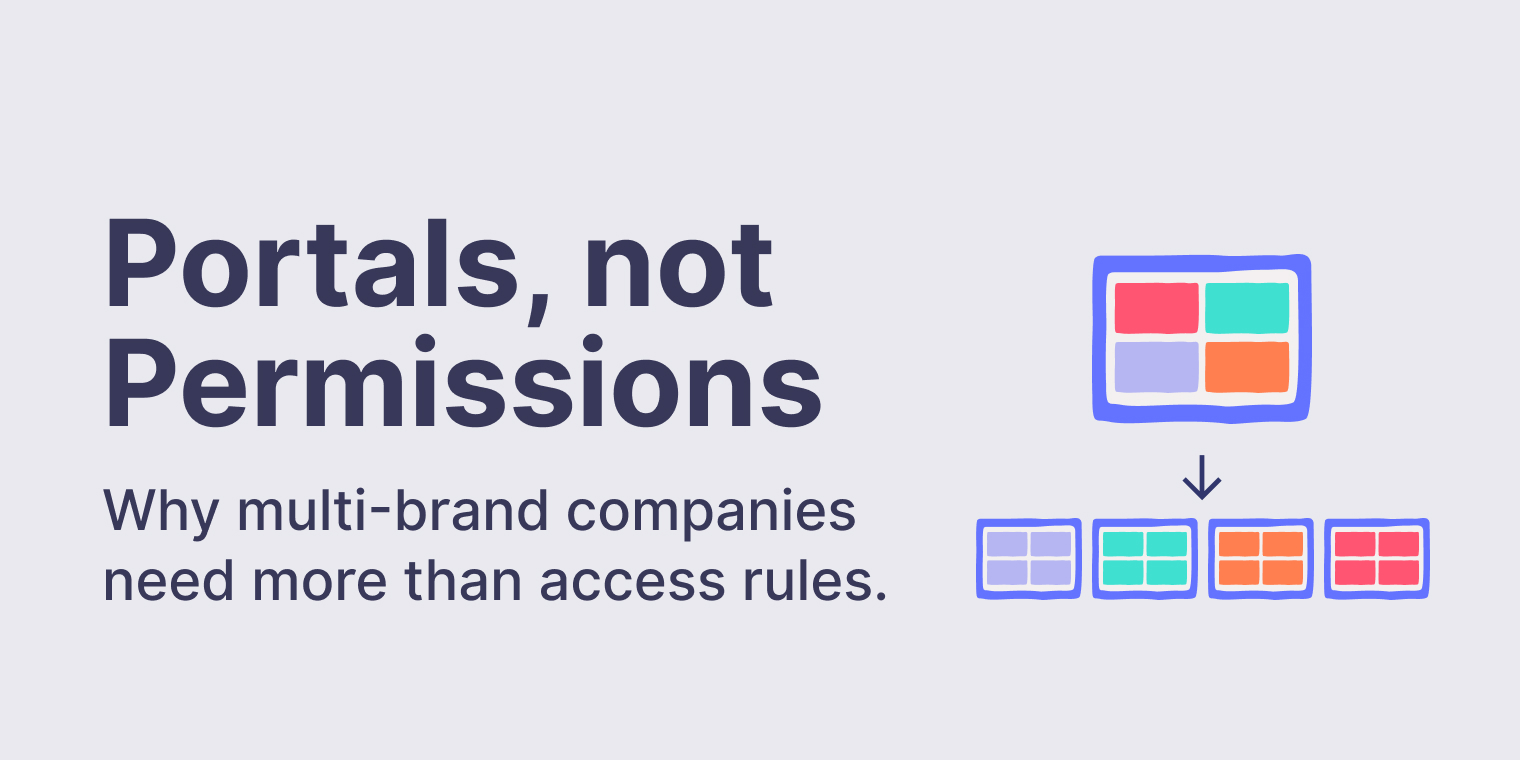
The multi-brand companies getting real value out of their DAM aren't just permissioning a shared library. They're running separate, self-contained portals for each brand.
Here's the distinction that matters:
A permission system says: you're allowed to see this folder.
A portal says: this is your world. No other brand's content exists here.
For a distributor working with three of six brands in a portfolio, that difference is everything. They log into a portal built around exactly what they carry. No searching around brands that don't apply to them. No confusion about which version of a logo belongs to which brand. No accidental co-mingling of assets that were never meant to sit in the same folder.
What this looks like in practice:
- Each brand gets its own portal, toggled independently, not just filtered from a shared pool
- Assets from one brand never appear inside another brand's portal, even to admins browsing casually
- Distributors, retailers, or partners see only the brands they're authorized to sell, with everything organized the way that specific brand's team wants it organized
- A brand manager for one label is responsible for their own portal, without needing to coordinate structure decisions across five other brand teams
This is the setup we saw work at the beverage conglomerate I mentioned. Every brand in their portfolio runs its own portal, managed by its own brand manager, accessible only to the distributors carrying that specific brand. A distributor selling three brands out of six sees exactly three portals. Nothing more.
Sales Enablement Is the Real Payoff
Here's the part that gets missed when people think about multi-brand DAM purely as an organization problem: the biggest win isn't tidier folders. It's revenue.
When a distributor can see a brand they don't currently carry, browse its assets, and get a feel for how it could sell in their market, that portal becomes a sales tool. Not a filing cabinet. A conversation starter.
The beverage company's team described this directly: distributors seeing brands outside their current lineup, through the portal, has become part of how new placements happen. The asset library isn't just supporting sales. It's participating in it.
This only works if the experience feels effortless. A distributor sizing up a new brand isn't going to dig through nested folders or guess at file names. They need something closer to shopping: browse, preview, download, done. The multi-brand companies that treat their DAM like an internal e-commerce experience, familiar, visual, fast, are the ones turning portals into pipeline.
Migration Doesn't Have to Mean Starting From Scratch
The most common objection we hear from multi-brand companies considering a switch is the fear of migration. Multiple brands usually means years of accumulated assets, inconsistent naming, duplicate files, and tagging that made sense to whoever set it up five years ago and nobody since.
We've written before about what a good DAM migration actually looks like, so I won't repeat all of it here. But it's worth saying directly: for multi-brand accounts specifically, most of the heavy lifting doesn't fall on your team.
When the beverage conglomerate moved off their previous system, our team ran a full content audit before a single brand manager logged in. Folder hierarchy, tagging structure, naming conventions, all built out ahead of time using AI-assisted analysis of their existing library. By the time their team saw the new system, 80 to 90% of the organizational structure was already done. Brand managers weren't building a system. They were moving into one.
For a company managing one brand, that's a nice convenience. For a company managing six, ten, or twenty, it's the difference between a migration that takes a quarter and one that never gets prioritized at all.
Watch for Price Creep as You Scale Brands
One thing worth naming directly: a lot of enterprise DAM pricing scales with the number of brands, portals, or seats you add. What looks like a reasonable cost with two brands becomes a very different number at six or ten.
Multi-brand companies feel this more than anyone, because the DAM isn't a single line item. It's a cost that multiplies alongside your portfolio. Worth asking directly, before you sign anything: does this pricing model reward us for growing, or penalize us for it?
What to Look for If You're Managing Multiple Brands
If your company is managing more than one brand, whether that's two labels or twenty, here's what actually matters in a DAM:
- True portal isolation, not just permission layers on a shared library
- Independent brand ownership, where each brand manager controls their own portal without needing to coordinate across every other brand
- A distribution experience that feels like shopping, not filing, since your external partners are using this to sell, not just reference
- Migration support that does the heavy lifting, especially if you're bringing over years of inconsistent structure across multiple brand libraries
- Pricing that doesn't punish you for growing your portfolio
Multi-brand distribution isn't a bigger version of the single-brand problem. It requires a different setup entirely, one where each brand gets to be its own world, and the system connecting them makes selling easier instead of harder.
Want to see what portal-based multi-brand distribution looks like for your brands? Request a demo.